
I was buried under piles of line-lists and Excel sheets in a government office a few miles away from the scene on that Thursday afternoon at a prominent government hospital in Ahmedabad. I was State PPTCT (Prevention of Parent to Child Transmission) Consultant under NACP-III, and my world was defined by data-tracking every single HIV-positive pregnant woman in the state to ensure zero transmission to the unborn.
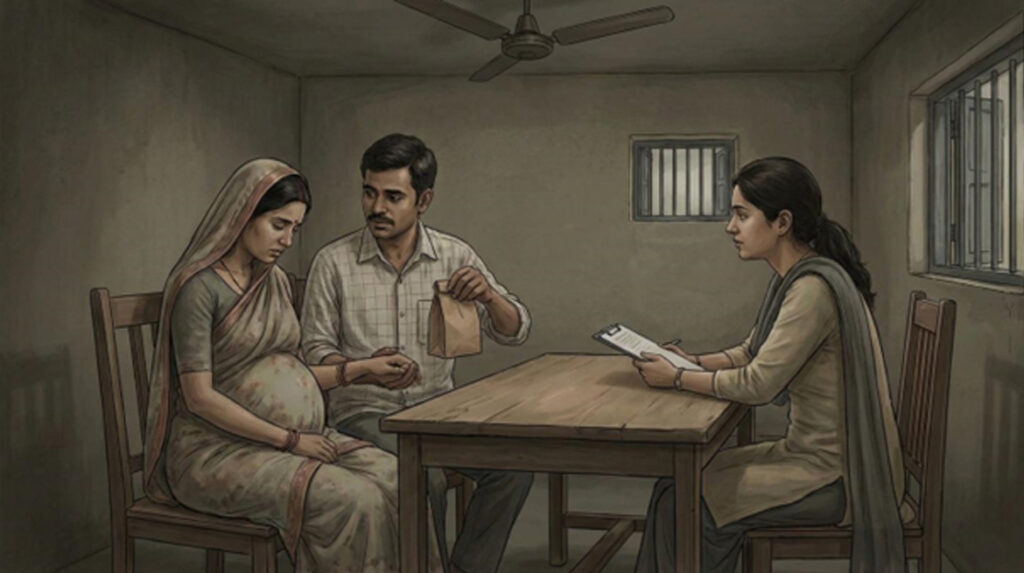
Of the thousands of names on spreadsheet, one story traveled back to me. A counselor brought it to my attention, and out of pure curiosity, I started looking into the life that was behind the line item. Her name is Kamala. Based on the counselor’s notes, I can see the scene as vividly as if I had been standing in the corner. The fan cutting through the humid air. The heavy silence. In the ICTC, Kamala, who is seven months pregnant, sits in a worn Rajasthani sari. The counselor had said, “Ben.” “The report is favorable.” Kamala reluctantly smiled. In her world, being ‘positive’ usually meant something good. That word was a sentence here, she was unaware of. Kamala didn’t cry when the explanation came: the virus, blood, and a lifelong treatment. She drew back. She physically folded into herself, pulling her pallu over her face, waiting for the world to end.
Then came the question that terrifies every woman in her position: “Where is your husband? He needs to be tested.”
He was waiting outside. Kishan. A daily wager, thin as a reed, face etched by the sun. He walked in, clutching a greasy plastic bag containing two warm samosas he had bought for them.
The exam lasted for fifteen minutes. Would he leave her if he said no? Even when a woman is the victim, she is frequently the vessel of blame in our society. The kit only showed one line. Non-Reactive. Negative!
Kamala stopped breathing. She was now “damaged goods” and knew their village’s brutal math. She braced herself for the anger. She waited for the accusation of infidelity.
Instead, Kishan looked at the counselor and asked in a rough dialect, “So… is she going to die?”
“No,” the counselor said. She will lead a normal life with the help of medicine. “And the infant?” “We will try our best to save the baby.”
Kishan sat back. He looked at the samosas in his hand, then at his wife, who was shaking. He reached out, took her hand, and placed the food in it.
“Eat,” he said quietly. “The baby is hungry.”
As I tracked Kamala’s case file over the next few months, the ghosts of her past emerged, story that maps the hidden epidemic of our country.
Kamala was from a small Rajasthani village. She had a young marriage to a truck driver who worked the highway and came home with money but also a sickness. He died within three years of the marriage after suffering from ‘inexplicable’ illness. His and her families probably suspected it, but in our patriarchal systems, silence is the currency of honor. Instead of testing her, they arranged a remarriage. Quickly. Quietly. She was married off to Kishan, a poor laborer in Gujarat who knew nothing of the virus. She was the victim of a conspiracy of silence.
But biology keeps no secrets. The pregnancy unmasked the truth. She was now afraid that this kind man would throw her out. However, Kishan was made of different materials. I was very attentive to their compliance data. We put Kamala on periodic testing and ART and ensured the delivery was institutional. This was the miracle of the PPTCT program – Nevirapine, and erstwhile protocols. However, protocols cannot function without people. Kishan, who could not read the prescription, memorized the colors of the pills so she doesn’t miss a dose. In a slum where gossip travels faster than light, he stood like a wall between the world and his wife.
Kamala had a girl born to her. We tested the child at 6 weeks, 6 months, 18 months. Negative!
Another child was born two years later. Negative!
They were a discordant couple – she positive, he negative; living in a one-room hut in a slum, raising two healthy children.
But life is rarely a straight line. After a few years, Kamala lost her baby to stillbirth. The pain was tremendous. Then, she developed Herpes Zoster Ophthalmicus. She lost vision in her right eye despite treatment because it ravaged the facial nerves. I quit my job as a State Consultant fifteen years ago to follow in my family’s footsteps and teach medical education. However, some tales stick with you. I kept in touch, watching them from a distance.
I learned that Kishan isn’t a saint carved in marble. He really is a man. He occasionally finds a “potli,” or desi liquor, in the dry state of Gujarat to unwind after a long week of work. He gets loud, he makes merry, he is flawed. But he never left!
I met Kamala recently. She is now in her late 30s, healthy, with an undetectable viral load. Her children are in school, oblivious to the storm their parents weathered.
Kishan came up to us as we were speaking. He looked older, grayer, smelling faintly of the day’s labor and perhaps a bit of that potli. In his hand, he held a familiar greasy plastic bag. He pulled out a samosa and handed it to her without a word.
It was a small gesture, identical to the one fifteen years ago.
I asked her, “Kamala ben, it has been a long journey. Through sickness, through blindness… how did you manage?”
She took a bite of the samosa, looked at her husband, and then touched the side of her face where the light had gone out forever. She smiled, a genuine, radiant smile that erased the years of pain.